Urban logistics is changing faster than the vehicles that sustain it.
Urban logistics is undergoing an unprecedented transformation.
The growth of e-commerce, new restrictions on access to urban centres, the expansion of Low Emission Zones (LEZs) and the need to make more deliveries in less time are forcing a rethink of how goods move within cities.
However, there is a clear contradiction.
While cities are evolving, a large part of delivery operations still use vehicles designed for a completely different reality.
The consequence is clear: it is becoming increasingly difficult to maintain profitability, efficiency and productivity in the last mile.
The origin of the problem: current vehicles were not designed for urban logistics
Traditional vans were designed to transport goods between different geographical points.
Motorbikes were designed for individual mobility.
Lorries for moving large volumes of cargo.
None of them were conceived with an urban environment in mind, characterised by:
- High traffic density.
- Environmental restrictions.
- Parking difficulties.
- Frequent, short-distance deliveries.
- Need for access to pedestrian or restricted areas.
- High pressure on delivery times.
For decades, the sector has tried to adapt these tools to new operational needs.
But adapting is not the same as designing.
And that difference has a cost.
The hidden cost of using unsuitable vehicles for the last mile
When a company analyses a fleet, it usually focuses on visible variables:
- Purchase price.
- Renting.
- Energy consumption.
- Maintenance.
However, the true cost is often found in less obvious factors.
Unproductive time
Drivers spend a significant part of their day searching for parking, accessing congested areas, or performing complex manoeuvres.
Lower productivity per route
Oversized vehicles for urban environments reduce the capacity to make more deliveries per hour.
Increase in operating costs
More time on the road means higher labour costs, increased operational wear and tear, and reduced profitability.
Access limitations
Urban restrictions continue to increase in cities across Europe, directly affecting traditional delivery models.
Lower overall efficiency
The sum of small downtimes generates a significant loss in daily productivity.
For this reason, more and more operators are stopping asking themselves what vehicle to buy and starting to ask themselves how to optimise the entire operation.
Un vehículo diseñado específicamente para la última milla debe tener las siguientes características:
* **Tamaño compacto y agilidad:** Capaz de navegar por calles estrechas, evitar el tráfico y encontrar aparcamiento fácilmente.
* **Eficiencia:** Bajo consumo de combustible o electricidad, para mantener los costes operativos bajos, especialmente en operaciones de alto volumen.
* **Bajo coste de adquisición y mantenimiento:** Para que la inversión inicial y los gastos continuos sean manejables.
* **Fiabilidad:** Debe ser capaz de operar de forma constante sin averías frecuentes, minimizando el tiempo de inactividad.
* **Capacidad de carga adecuada:** Suficiente espacio o capacidad para transportar el volumen y peso típico de los paquetes de la última milla.
* **Facilidad de carga y descarga:** Diseñado para permitir un acceso rápido y eficiente a la carga.
* **Seguridad:** Tanto para el conductor como para la carga, y para ser visible en entornos urbanos concurridos.
* **Sostenibilidad (opcional pero deseable):** Opciones eléctricas o híbridas para reducir la huella de carbono y cumplir con regulaciones ambientales.
* **Tecnología integrada (opcional):** Sistemas de navegación, seguimiento y gestión de flotas para optimizar las rutas y la eficiencia.
* **Comodidad para el conductor (en algunos casos):** Si la operación implica muchas paradas y arranques, la comodidad puede mejorar la productividad.
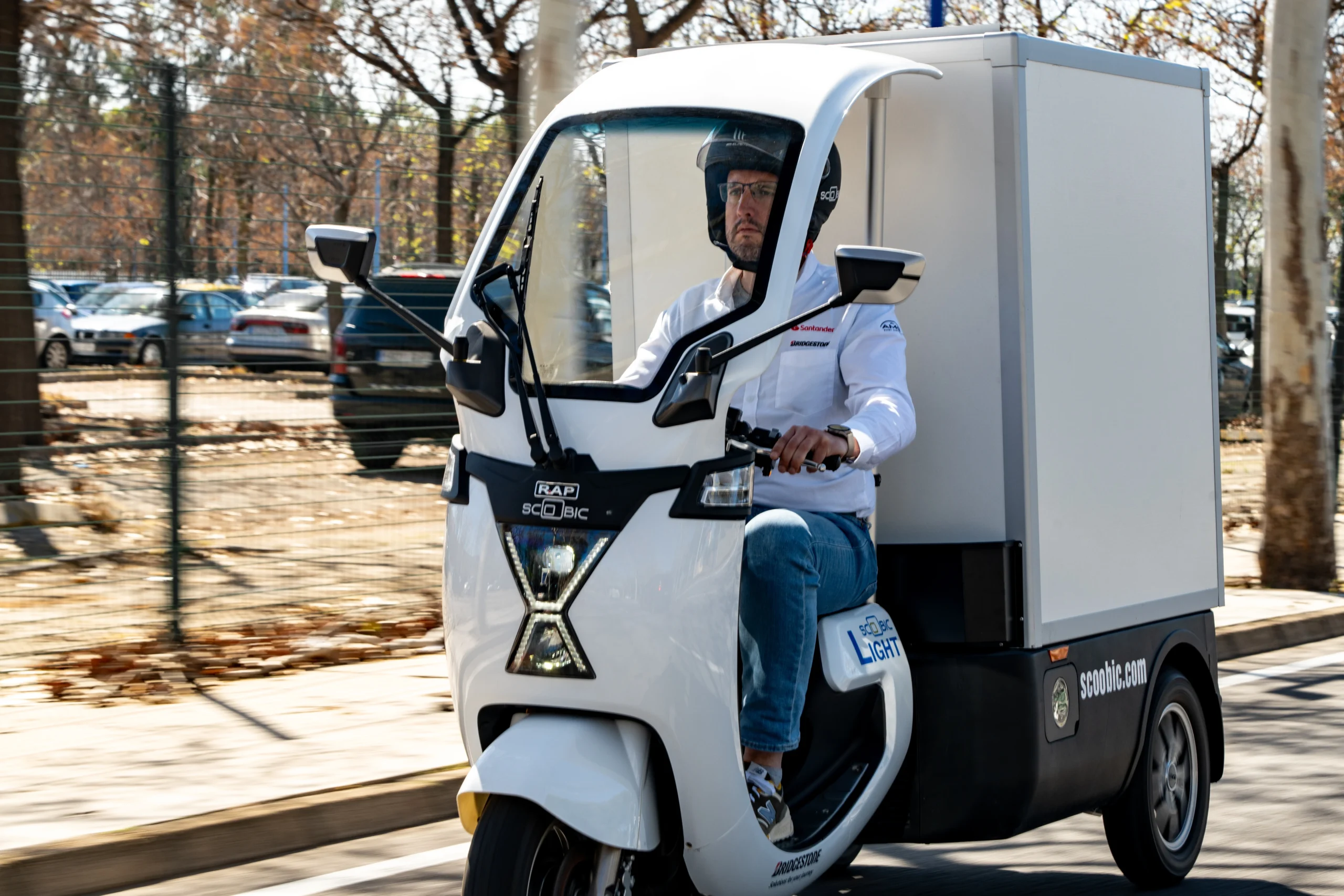
The evolution of urban logistics demands a new generation of solutions.
It's not enough to electrify a traditional van.
The concept needs to be completely rethought.
A vehicle truly designed for the last mile should bring together features such as:
High urban operational capacity
Sufficient capacity to transport goods without compromising agility in complex urban environments.
Ease of access and parking
Designed to reduce non-productive time associated with deliveries.
Reduced operating cost
Lower energy consumption, less maintenance, and maximum operational availability.
Adaptability
Ability to respond to different types of delivery:
- Parcel service.
- Feeding.
- Public services.
- Urban distribution.
- Retail.
Safety
Protection for both the delivery person and the urban environment.
Connectivity
Integration with digital systems to optimise routes, maintenance and productivity.
The future of urban logistics isn't vehicles; it's systems.
One of the biggest mistakes in the market is thinking that transformation only involves swapping one vehicle for another.
True evolution lies in integrating three dimensions that have historically operated separately:
Mobility
Vehicles designed specifically for the city.
Energy
Energy-efficient models that reduce costs and increase availability.
Data
Real-time information to optimise routes, maintenance, consumption and productivity.
The combination of these three elements allows for the creation of much more efficient operations than those based exclusively on the substitution of traditional vehicles.
The emergence of a new logistical species
Urban logistics no longer needs more adapted vehicles.
It needs tools designed from scratch to respond to the challenges of modern cities.
The next generation of logistics operators will not compete by having larger fleets.
They will compete by having more efficient operations.
More connected.
More profitable.
And better prepared for future urban restrictions and demands.
That’s why the great transformation of the last mile is not about electrifying existing infrastructure.
It’s about creating a new logistical species.
A category of solutions designed specifically to multiply urban productivity and allow cities to keep growing without collapsing.
Conclusion
Urban logistics is facing one of the biggest transformation processes in its history.
Cities are changing.
Consumer habits are changing.
Operational demands are changing.
And the tools used to deliver goods must also evolve.
The question is no longer which vehicle to use.
The question is what operational model will allow more deliveries to be made, with fewer resources and greater profitability over the next ten years.